
Voice over Internet Protocol (VoIP) is revolutionizing communication by allowing voice calls to be made over the Internet rather than through traditional phone lines. This cutting-edge technology transforms your voice into digital data packets, which are sent via broadband connections. VoIP not only delivers substantial cost savings on both domestic and international calls but also offers a range of advanced features, such as call forwarding, voicemail-to-email, and video conferencing.
This article delves into the concept of VoIP, its operational mechanics, and the advantages it offers to individuals and businesses, highlighting its appeal as a modern communication solution.
What is VoIP?
Voice over Internet Protocol (VoIP) is a technology that facilitates voice communication via the Internet. It converts voice signals into digital data packets, allowing calls from computers, smartphones, or VoIP phones. Key advantages include reduced long-distance call costs, features like video conferencing, and the flexibility to communicate from any location with internet access. VoIP has transformed communication by offering versatile and cost-effective voice services.
How Does Voice Over Internet Protocol (VoIP) Work?
VoIP services convert voice into digital signals that travel over the Internet. When calling a regular phone number, the signal is transformed back into an analog signal before reaching its destination. VoIP enables calls directly from a computer, a special VoIP phone, or a traditional phone with a special adapter. Wireless hotspots in places like airports, hospitals, and cafes allow you to connect to the Internet and use VoIP services wirelessly.
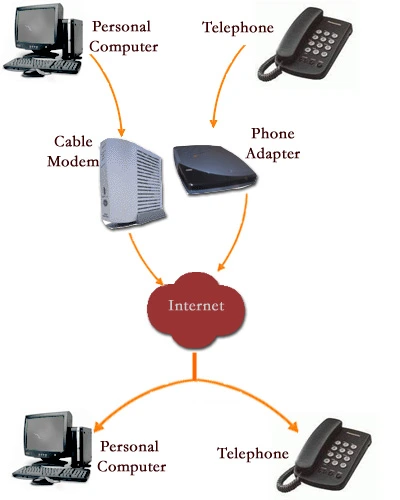
Equipment Required in VoIP
- An Internet connection must be very high-speed to use VoIP services.
- Internet access can be via cable modem or LAN and other high-speed services.
- Users need compatible devices, such as computers, adapters, or special VoIP phones.
- Some VoIP services only work through a specific computer or VoIP phone.
- Other services give you the option of using a traditional phone that comes with a VoIP adapter.
- Computer-based tests require inexpensive software and microphones.
- VoIP phones can be connected directly to a broadband connection.
- They work like traditional telephones.
- Using a phone with a VoIP adapter, users can dial numbers as usual.
- In such cases, the service can provide a voice call.
Evolution of VoIP Service
The COVID-19 pandemic led millions of administrators and office professionals to transition to remote work, significantly benefiting the VoIP sector. As teleconferencing became the new norm in workplaces, VoIP and related services like Zoom gained increased importance for office management.
Local Call vs Long Distance Call
Some VoIP providers offer free services, usually limited to calls between their users. You might have the option to choose an area code different from your own. However, this could result in charges for long-distance calls, depending on the area code and service. Like traditional phone services, certain VoIP companies charge for long-distance calls to numbers outside their designated calling area. Other providers offer calls to any location for a fixed number of minutes at a predetermined rate.
Is VoIP Regulated by the FCC?
Additionally, the FCC requires interconnected VoIP providers to comply with the Communications Assistance for Law Enforcement Act of 1994 (CALEA) and contribute to the Universal Service Fund, which supports phone subscribers with specific income qualifications and communication services in high-cost regions.
Advantages of VoIP
- Some VoIP services offer features and services that are not available with a traditional phone or are available but only for an additional fee.
- Paying for both a broadband connection and a traditional telephone line can be avoided.
- VoIP technology practically eliminates the expense of phone communication for both business and personal use.
- VoIP phone service is frequently offered by Internet providers as a free perk for purchasing broadband or higher-speed Internet access as well as Internet cable television channels.
- Everyone who benefits from the transaction wins because the Internet provider has to pay a little bit more for this service, but the consumer doesn't pay any more for it.
Disadvantages of VoIP
- Some VoIP services don't work during power outages, and the service provider may not offer backup power.
- Not all VoIP services connect directly to emergency services through emergency service numbers.
- VoIP providers may or may not offer directory assistance.
- VoIP services' primary drawback is their propensity to cluster or lag. The sound is a little bit delayed because it is sent in packets. In most cases, inexperienced listeners won't be able to distinguish between VoIP and analogue calls.
- If neither the user nor the supplier has backup power, several VoIP services cannot function during blackouts.
Difference between VoIP and Traditional Phone Services
Features | VoIP | Traditional Phone Services |
Method of transmission | Digital Signals | Analog Signals |
Internet requirement | Yes, high-speed broadband | No, traditional phone line |
Cost | Lower cost for long-distance | Higher cost for long-distance |
Features and services | More features and services | Limited features and services |
Power outages | May not work | Usually works |
Emergency services access | May not connect directly | Direct connection |
Directory assistance | May or may not be available | Usually available |