From automated scheduling to diagnostic assistants, Artificial Intelligence is no longer a futuristic concept in medicine—it is already operating inside clinics and hospital networks every day.
While headlines often depict AI as a potential replacement for doctors, the reality on the ground is quite different. Modern clinical AI operates primarily as a powerful force multiplier, tackling administrative overhead, speeding up diagnostics, and surfacing hidden patterns in patient data.
Here is a look at where AI is making its most significant impacts in healthcare today, along with the real-world challenges standing in its way.
Eradicating the Administrative Burden
The average physician spends a substantial portion of their day on documentation, entering clinical notes, and updating Electronic Health Records (EHR). This administrative strain is a primary driver of clinician burnout across the industry.
- Ambient Clinical Intelligence: Generative AI tools listen into patient-clinician conversations in real time, drafting structured, compliant clinical notes automatically.
- Workflow Automation: Ambient scribes and ambient copilots allow care providers to maintain direct eye contact and focus on the patient rather than staring at a screen.
Accelerating Medical Imaging & Early Detection
Radiology and pathology generate vast amounts of visual data daily. Deep learning algorithms excel at pattern recognition, making them ideal diagnostic assistants.
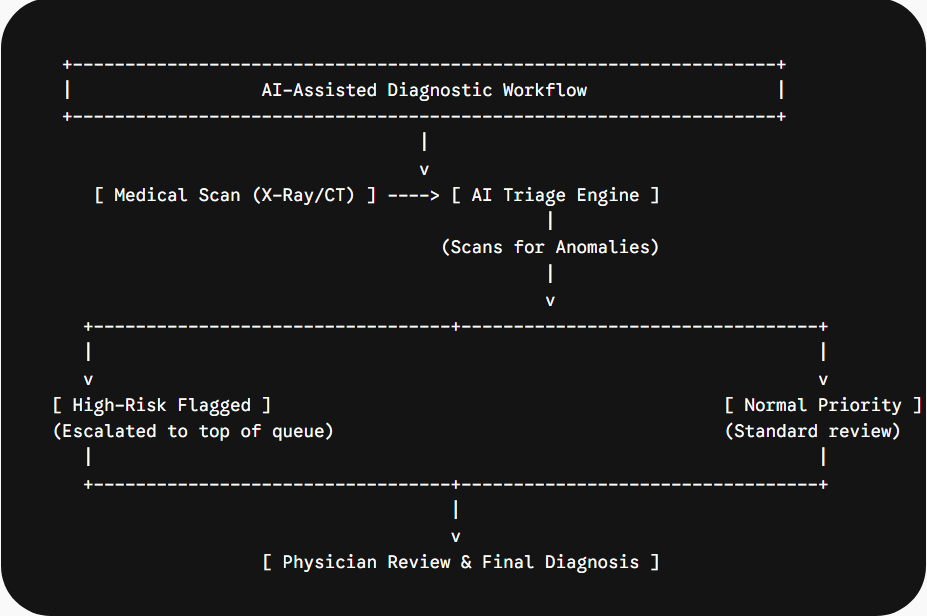
- Radiology Triage: AI algorithms scan X-rays, CTs, and MRIs to flag urgent abnormalities like intracranial hemorrhages, pulmonary embolisms, or fractures.
- Prioritizing Critical Scans: By prioritizing critical scans at the top of a radiologist's queue, these tools significantly reduce turnaround times for high-risk patients.
- Virtual Biopsies & Cancer Detection: Advanced 3D modeling tools analyze tumor pathology and clinical data to estimate risks and assist in personalized surgical planning.
Precision Medicine & Drug Discovery
Historically, drug discovery was a multi-year, multi-billion-dollar trial-and-error effort. AI accelerates this pipeline by predicting chemical interactions, target proteins, and compound behaviors before a single physical lab test occurs.
In personalized oncology, multimodal AI platforms combine genomic testing, pathology, and imaging history to recommend targeted therapies tailored specifically to an individual patient’s biological profile.
The Core Challenges Facing Healthcare AI
Despite rapid technological progress, deploying AI in high-stakes medical environments comes with clear responsibilities:
Challenge | Real-World Impact | Key Mitigation |
Algorithmic Bias | Training models on narrow demographic data can lead to poorer predictive accuracy for underrepresented populations. | Using diverse, representative datasets and continuous bias audits. |
Data Privacy & Governance | Medical records require strict compliance with regulations (like HIPAA and GDPR). | Federated learning approaches that train models locally without centralizing patient data. |
The "Black Box" Problem | Clinicians need to understand why an AI model made a specific prediction before acting on its guidance. | Developing Explainable AI (XAI) frameworks and keeping a human in the loop. |
Looking Ahead: The Human-in-the-Loop Model
AI is not here to make clinical decisions independently. The future of healthcare lies in augmented intelligence—where human expertise is augmented by algorithmic speed and precision.
By automating repetitive administrative tasks and acting as a second set of eyes on complex clinical data, AI gives doctors back what they need most: time to deliver empathetic, personalized patient care.